

Waycore & aggregators solve different problems.
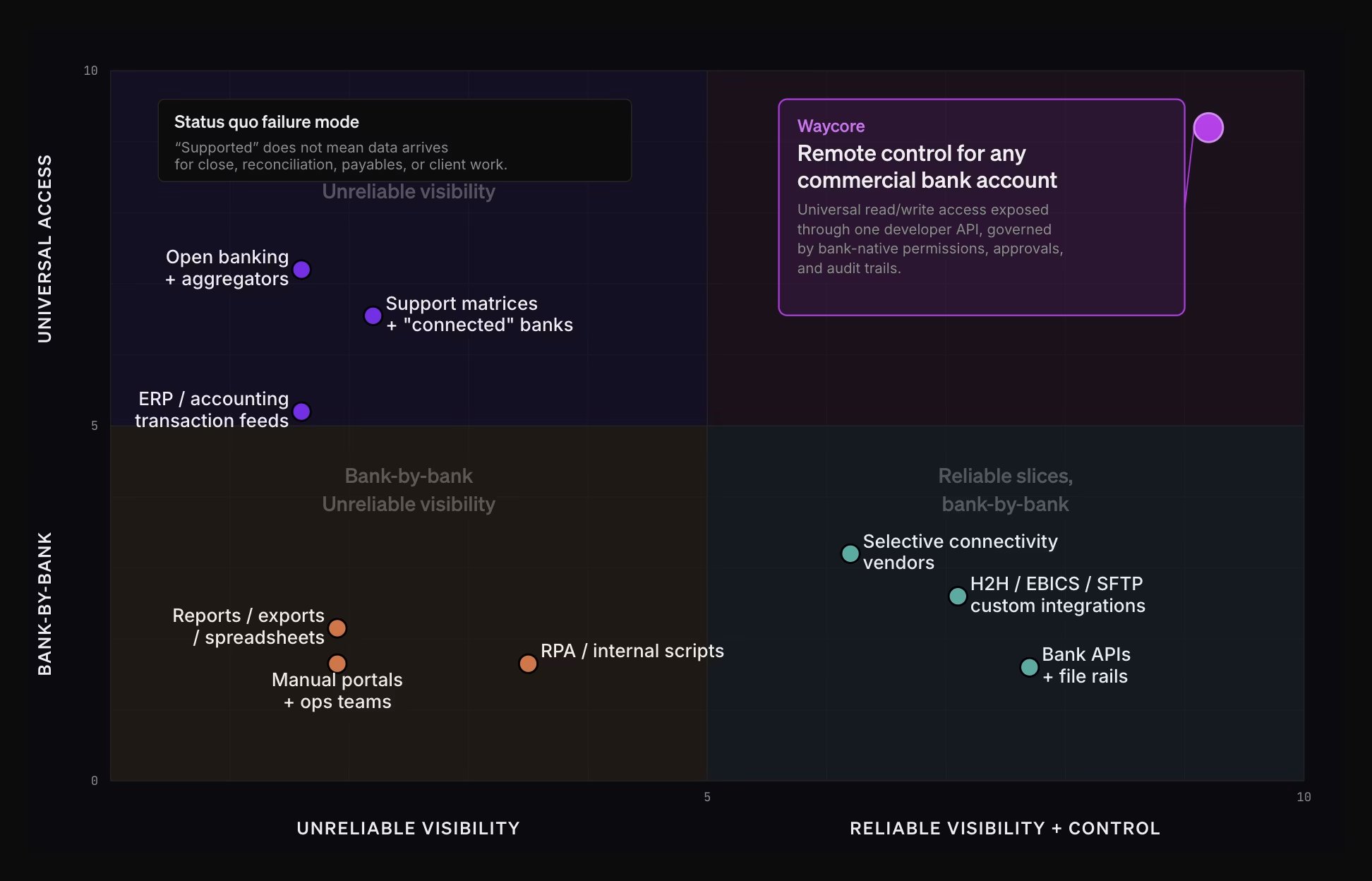
Where aggregators work well
Aggregators are genuinely good infrastructure for consumer fintech apps, SMB lending, and basic cash-flow dashboards. The aggregator model is a good choice when the integration requires read-only access, the target accounts are retail or simple SMB, and there is no requirement for payment execution or deterministic reliability.Where aggregators fail in commercial banking
Our own first-hand experience trying to build real-time treasury applications on top of standard aggregators confirms these failure modes are systemic for commercial workflows:- Geographic and institutional coverage: Aggregators maintain a fixed catalog of supported institutions, weighted heavily toward US retail and SMB accounts. Adding a bank outside that catalog requires a new integration, which may take months or never happen.
- No near real-time data: Aggregators batch and delay data. For execution workflows like payments, sweeps, and approval chains, you need to know the current state of an account before you act on it. Aggregators cannot reliably deliver this.
- Commercial portal coverage: Aggregators are optimized for consumer accounts. An aggregator’s dashboard may list a major institution like Chase or Morgan Stanley as “supported,” but attempting to pull reliable data from their commercial portals is often a terrible experience.
- Missing commercial features: Because they do not specialize in commercial banking, aggregators completely lack support for core treasury features.
- No execution: Aggregators are read-only data pipes. They cannot reliably support commercial payment workflows like staged transfers, approval chains, or bulk payroll uploads.
- Poor developer support: When a bank updates its portal and an aggregator connection breaks, resolution can take months. The developer experience is notoriously poor, with no human fallback to maintain continuity.